
For finance leaders under pressure to control costs without sacrificing quality, hiring accountants in Latin America has become one of the smartest moves available. The region offers a deep pool of credentialed, English-speaking accounting professionals who work in your time zone and cost a fraction of what comparable talent commands in the United States or Canada. Whether you need a staff accountant, a controller, or a full accounts-payable team, Latin America deserves a serious look.
This guide walks through why the region works so well for accounting roles, what it costs in real dollars, where to find the best talent, and how to structure a hire that holds up over the long run.
Why Latin America for Accounting Talent?
The case for nearshore accounting rests on four pillars: time zone alignment, cost savings, talent depth, and cultural fit. Unlike offshore hubs that sit 10 to 12 hours ahead, Latin American countries fall within one to three hours of U.S. business hours. Your accountant in Bogotá or Buenos Aires is online when your finance team is, which matters enormously during a month-end close or an audit crunch.
Cost savings are equally compelling. A senior accountant who would command $90,000 to $120,000 in a major U.S. metro can often be hired in Latin America for 30 to 70 percent less, commonly $35,000 to $55,000 a year, with no drop in technical capability. Those savings flow straight to your bottom line or free up budget to expand the team.
The talent pool is wide and well-trained. Countries across the region produce large numbers of accounting and finance graduates each year, many holding credentials that map cleanly onto U.S. standards. A growing share have worked for multinationals or Big Four firms and already understand GAAP, IFRS, and the cadence of a North American close.
Roles You Can Confidently Hire
Nearshore accounting is not limited to entry-level bookkeeping. Companies routinely staff a full ladder of roles from the region:
- Staff and senior accountants who own journal entries, reconciliations, and month-end close tasks.
- Accounts payable and accounts receivable specialists who manage invoicing, collections, and vendor relationships.
- Controllers who oversee the close, manage the books, and supervise junior staff.
- Financial analysts who build models, run variance analysis, and support budgeting and forecasting.
- Payroll and tax specialists familiar with multi-jurisdiction compliance.
The key is matching seniority to scope. A reconciliation-heavy role suits a detail-oriented staff accountant, while a role that touches strategy and reporting calls for a controller or analyst with more judgment.
What Does It Cost to Hire an Accountant in Latin America?
Here is where the numbers get concrete. The figures below reflect what U.S. companies typically pay remote accounting professionals in Latin America in USD, not local market salaries, which run lower, but the competitive rates that actually attract and retain talent working for North American teams. As a rule of thumb, hiring nearshore lands you roughly 30 to 70 percent below the U.S. equivalent for the same role and experience level.
A useful anchor: a senior accountant who commands around $120,000 in the U.S. typically runs $40,000 to $55,000 a year in Latin America. Across common accounting roles, the all-in monthly cost to the client, covering the professional plus a transparent staffing margin, tends to fall in the $1,800 to $3,000 per month range, with a blended average near $2,700.
Approximate annual ranges by role (remote-for-U.S.-company rates, 2026):
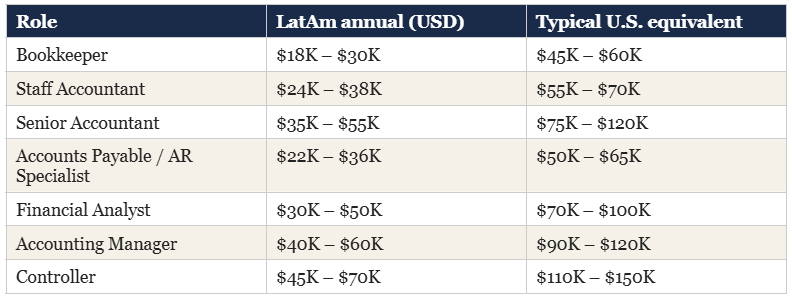
Country matters too. Costs vary across the region based on local markets, demand, and currency dynamics. Mexico and Colombia tend to offer the best balance of affordability and a deep talent pool. Brazil and Chile usually sit at the higher end, reflecting stronger local economies. Argentina has exceptional, highly analytical talent, but its currency volatility means most companies pay in USD and revisit compensation more often to keep offers competitive. Costa Rica, with its established finance and shared-services ecosystem, tends toward the mid-to-upper range for experienced corporate finance talent.
One important caveat: these are 2026 figures, and the region is inflationary. Salary increases for 2026 are running around 6 percent in Colombia and over 5 percent in Mexico, higher in Argentina. Treat the ranges as a current starting point and budget for annual cost-of-living adjustments rather than assuming today’s number holds indefinitely.
Beyond base salary, account for the engagement model. Some companies hire directly and run their own payroll and compliance; others work through a nearshore staffing partner that handles employment, benefits, and local tax obligations for a transparent margin. The partner route removes legal and administrative friction, which is often worth the fee for teams without an in-country entity.
Watch for hidden costs in opaque arrangements. The most reliable partners publish their pricing, a fixed margin on staff augmentation or a clear placement fee for direct hire, so you always know what you are paying for the talent versus the service.
Where to Find the Best Accounting Talent
Several countries stand out for accounting and finance roles. Argentina and Colombia are known for strong English proficiency and deep analytical training. Mexico offers proximity and a massive talent base. Costa Rica has built a reputation as a finance and shared-services hub, hosting back-office operations for many multinationals. Each market has its own strengths, and the right choice depends on the specific role and your time-zone preference.
Rather than fixate on a single country, focus on the candidate. A great controller in Lima will outperform a mediocre one in a "preferred" market every time. A good nearshore partner sources across the region and presents the strongest individuals regardless of borders.
How to Structure the Hire
A successful nearshore accounting hire comes down to a few disciplined steps:
- Define the role precisely. List the systems (NetSuite, QuickBooks, SAP), the standards (GAAP or IFRS), and the recurring deliverables. Specificity attracts the right candidates and filters out the wrong ones.
- Decide on the engagement model. Staff augmentation gives you a dedicated team member without the overhead of direct employment. Direct placement makes the person a full employee of your entity. Choose based on your long-term plans and compliance appetite.
- Vet for both technical and communication skills. Test accounting knowledge directly, but also assess written and spoken English, since these roles touch reporting and cross-team collaboration.
- Invest in onboarding. Give your new accountant the same documentation, access, and context you would give a local hire. Nearshore talent integrates fast when the foundation is set well.
Common Concerns, Addressed
Leaders new to nearshore hiring often raise the same questions. On data security, reputable partners enforce the same controls you would expect internally, secure access, NDAs, and compliance with relevant standards. On quality, the answer is rigorous vetting; the best firms present only pre-screened, top-tier candidates rather than flooding you with resumes. On retention, fair pay and genuine integration into your team keep nearshore accountants for years, not months.
Staff Augmentation vs. Direct Hire: Which Model Fits?
One decision shapes the entire engagement more than any other: how you bring the accountant onto your team. The two dominant models are staff augmentation and direct hire, and each suits a different situation.
Staff augmentation places a dedicated, full-time accountant on your team while a nearshore partner remains the legal employer, handling payroll, benefits, taxes, and local labor compliance. You manage the person’s day-to-day work and they function as part of your team, but you avoid the burden of establishing an entity or navigating foreign employment law. This model is ideal when you want to scale quickly, keep administration light, or test the nearshore approach before committing further. With a transparent partner, you pay a clear margin on top of the accountant’s compensation and always know what the service costs.
Direct hire (or direct placement) makes the accountant an employee of your own company, usually in exchange for a one-time placement fee. This suits organizations that already have an in-country presence or are prepared to manage international employment, and that want the person fully on their own payroll for the long term. It carries more administrative responsibility but gives you maximum control and direct ownership of the relationship.
There is no universally correct answer. Fast-growing teams and those without foreign-entity infrastructure usually start with staff augmentation; established operations building permanent headcount often prefer direct hire. A good partner will walk you through the tradeoffs honestly rather than pushing whichever model pays them more.
The Bottom Line
Hiring accountants in Latin America lets you build a stronger finance function for less, without the time-zone pain of traditional offshoring. The talent is credentialed, the savings are real, and the working relationship feels local. Define the role clearly, choose a transparent partner, and vet carefully, and you will end up with accounting professionals who close the books on time and grow with your company. Ready to explore nearshore accounting talent? Start by mapping the roles you need most, then evaluate partners on the clarity of their pricing and the quality of the candidates they put in front of you.

Revolutionize Your Workflow with Our Innovative BOT Strategy!
Enhance your operations seamlessly and adapt to market demands
Contact Us