
Building a Nearshore FP&A Function: Roles, Salaries, and What to Expect
Meta title: Building a Nearshore FP&A Team in Latin America: Roles & Salaries Meta description: FP&A talent is scarce and expensive in the U.S. Learn how companies build financial planning and analysis functions in Latin America, with role breakdowns and salary benchmarks. Suggested slug: building-nearshore-fpa-function-latin-america
Most conversations about nearshore finance staffing start with bookkeeping and accounts payable, and for good reason: those roles are the easiest entry point. But the more interesting opportunity, and the one sophisticated finance leaders are moving on right now, sits one level up the value chain. Financial planning and analysis is one of the hardest functions to staff in the United States, one of the most expensive, and one of the best suited to nearshore hiring.
This article covers what FP&A work translates well to a nearshore model, what the roles cost, how to structure the function, and what separates the companies that succeed at this from the ones that end up with an expensive spreadsheet jockey nobody talks to.
Why FP&A Is So Hard to Staff Domestically
FP&A sits at the intersection of accounting knowledge, modeling skill, and business communication, and people who combine all three are scarce everywhere. In the U.S., the scarcity is compounded by demand: private equity portfolio companies, growth-stage startups, and mid-market companies professionalizing their finance functions are all chasing the same analysts. Compensation reflects it. A capable senior financial analyst in a major U.S. market often costs more than a controller did a decade ago, and FP&A managers and directors command six figures well into the mid-100s before bonus.
Meanwhile, the actual work of FP&A is almost perfectly remote-compatible. It lives in Excel, Google Sheets, and planning tools like Adaptive, Anaplan, Cube, or Mosaic. Its inputs come from the ERP and the CRM. Its outputs are models, dashboards, and narratives delivered over video calls. There is no physical component and, unlike some accounting roles, relatively little document handling. What FP&A does require, intensely, is real-time collaboration: budget reviews with department heads, live scenario modeling in leadership meetings, quick turnarounds when the CEO asks “what happens if we push the launch a quarter?”
That collaboration requirement is exactly why the offshore model, with a ten-hour time difference, has historically failed for FP&A while succeeding for transactional accounting. And it is why nearshore, with same-timezone talent across Latin America, is the model that actually works for this function.
The LATAM FP&A Talent Pool
Latin America has a deep and underappreciated bench of FP&A talent, built by three forces:
Multinational shared services and regional HQs. Companies like Procter & Gamble, Nestlé, Coca-Cola, and dozens of banks have run regional finance centers in Mexico City, San José, Bogotá, and Buenos Aires for decades. These centers train analysts in corporate budgeting, variance analysis, and management reporting at global standards, in English.
Big Four and consulting alumni. The Big Four maintain large practices across the region, and their alumni carry rigorous financial analysis training into the market every year.
Strong quantitative education. Finance, economics, and industrial engineering programs at universities like Tec de Monterrey, Universidad de los Andes, and Universidad de Buenos Aires produce graduates with strong modeling fundamentals, and the ones pursuing international remote careers are self-selected for English fluency.
The result is a candidate pool with genuine corporate FP&A experience, often with U.S. reporting exposure, available at compensation levels that change the economics of building the function.
Roles and Salary Benchmarks
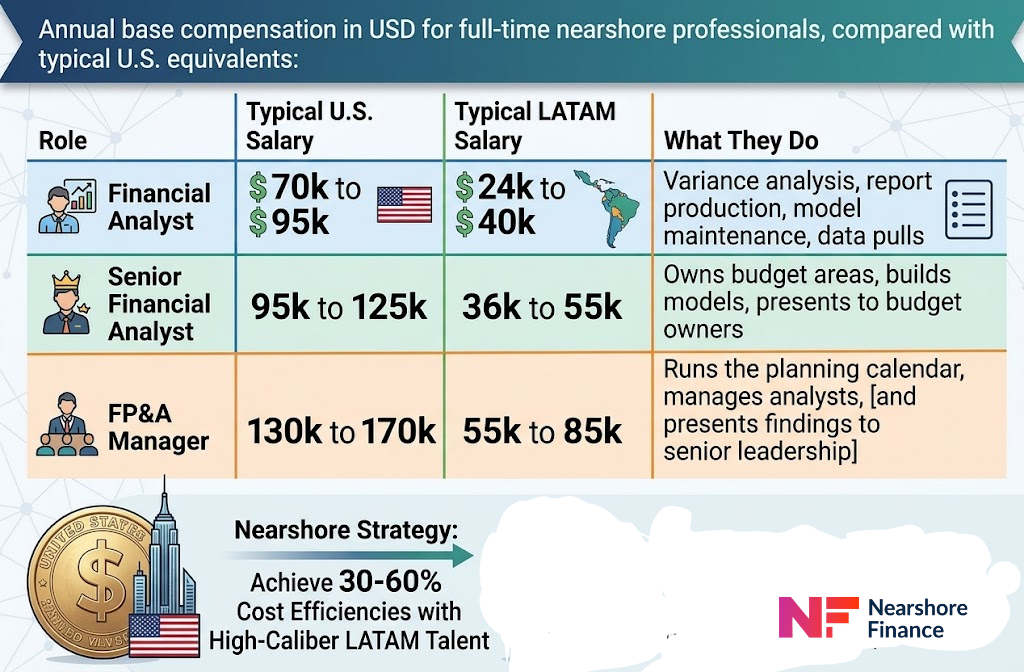
As with accounting roles, candidates with specific tool experience (NetSuite, Adaptive, Power BI, Tableau, advanced SQL) and industry experience (SaaS metrics, ecommerce unit economics, manufacturing cost accounting) command the upper end of each range. Even so, fully loaded costs typically land 45 to 60 percent below U.S. equivalents.
What Nearshore FP&A Looks Like in Practice
The strongest implementations we see follow a consistent shape.
Start with the reporting layer. The first nearshore FP&A hire usually takes over the recurring production work that consumes your existing team: the monthly reporting package, departmental budget-vs-actual reports, KPI dashboards, and the data assembly behind board decks. This work is well defined, deadline-driven, and immediately measurable, which makes it the right proving ground.
Move to analysis. Within a quarter, a good analyst graduates from producing reports to explaining them: writing variance commentary, flagging trends, investigating anomalies before anyone asks. This is where the role starts returning insight, not just labor.
Then business partnering. The mature state is a nearshore senior analyst or manager who owns relationships with specific budget holders, joins their monthly reviews, models their scenarios, and pushes back on their assumptions. Timezone alignment is what makes this stage possible. A budget partner who cannot attend the budget meeting is not a partner.
Pair FP&A with your accounting hires. Companies that already run nearshore accountants have a structural advantage: their FP&A analyst sits next to, organizationally speaking, the people who produce the actuals. A pod containing a staff accountant and a financial analyst, sharing context daily, closes the classic gap between “what the books say” and “what the forecast assumed.”
What to Get Right
Give them access to the business, not just the data. The number one failure mode for any FP&A hire, domestic or nearshore, is isolation. An analyst who never talks to sales, operations, or department heads produces mathematically correct models built on stale assumptions. Put your nearshore analyst in the meetings where the business is discussed. Introduce them to budget owners as a partner, not a back-office resource.
Invest in context transfer early. FP&A quality is a function of business understanding. Spend the first month the way you would with any strategic hire: how the company makes money, what drives each line, what leadership actually worries about. The modeling skills arrive on day one. The context is your job to provide.
Define ownership, not tasks. “Own the monthly reporting package, delivered by business day five, with commentary” builds a professional. “Update this spreadsheet when asked” builds a bottleneck.
Set a communication standard for deliverables. Good FP&A output is a narrative, not a tab. Make written summaries part of every deliverable from week one, and give feedback on the writing the same way you give feedback on the numbers. LATAM professionals with shared-services backgrounds are typically strong here already, but every company’s voice is different.
The Economics of the Function
Consider a mid-market company that needs real FP&A capacity: one senior analyst and one analyst. In the U.S., that team costs roughly $190,000 to $230,000 in base salary alone, plus 25 to 35 percent in benefits and payroll overhead, landing somewhere near $250,000 to $300,000 fully loaded. The equivalent nearshore team, fully loaded including partner fees, typically runs well under half of that.
That delta is not just savings. It is optionality. It is the difference between “we can afford one analyst, and the FP&A manager will have to keep doing production work” and “we can afford a real function.” Many of our clients do not pocket the difference; they use it to hire the second analyst they could never justify domestically, and end up with more analytical capacity than the U.S.-only plan would have produced at the same budget.
The Bottom Line
FP&A is no longer a function you have to overpay for or do without. The talent exists across Latin America, trained in the same corporate environments as their U.S. counterparts, working in your timezone, at compensation that lets mid-sized companies build the planning capability that used to be reserved for enterprises. The companies moving first are not just saving money. They are making better decisions, faster, because someone finally has time to do the analysis.
Nearshore Finance places financial analysts, senior analysts, and FP&A managers across Latin America, vetted for modeling skill, English fluency, and business communication. Contact us to scope your first FP&A hire.

Revolutionize Your Workflow with Our Innovative BOT Strategy!
Enhance your operations seamlessly and adapt to market demands
Contact Us